
From sharing our expertise to researching accessibility, Panthea has, for several years, engaged actively with academia. We see universities, art schools and translation programmes as forums where we share our experience, discuss our practices and help shape perspectives on surtitling.
Sharing our surtitling expertise
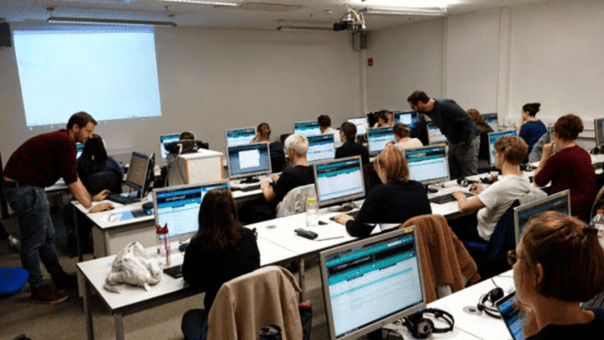
In Germany, Panthea collaborates with several institutions to share the fundamentals of surtitling and explore its creative possibilities. At Johannes Gutenberg University Mainz (Germersheim), we participate in a seminar on theatre surtitling every semester, while in Berlin, we run regular workshops at the Ernst Busch University of Theatre. Meanwhile, a workshop we ran at Leipzig University has since led to a collaboration with the Schauspiel Leipzig. Panthea also takes part in Leipzig University’s open day every year, introducing students to our work and providing concrete insights into the surtitling industry.
In France, we are about to begin a new collaboration with the University of Burgundy, which will be equipping itself with our surtitling software, Spectitular. At the University of Nice, Panthea has contributed to the seminar “Arts and Current Transformations (Ecology, Technology)”, which explores the links between creative practices, new technologies and accessibility.
Beyond these collaborations, Panthea continues to work with institutions across Europe. In particular, we have a close partnership with the Université libre de Bruxelles, which introduced a course on theatre surtitling as part of its Master in Translation several years ago and which has now purchased a panthea.live mobile kit. The University of Macerata in Italy is another key partner with whom Panthea shares its expertise, particularly around accessibility.This has led to a collaboration with the association AXESS and to participation in events at the Verona Arena, the Puccini Festival and other prestigious venues.
A largely unexplored research area
Academic research into surtitling and accessibility in the performing arts remains relatively scarce.
In May 2024, Panthea contributed to discussions around the adoption of Easy Language in the performing arts. At the conference ‘Stating the Aesthetics of Access’, organized by the University of Hildesheim, Maria Wünsche spoke about the creative potential of Easy Language as an artistic tool, above and beyond its role in mediation and accessibility.
From seminar rooms to stages across Europe, Panthea hopes that by continuing to engage with academia, it will help to raise awareness of surtitling, support the next generation and contribute to a collective reflection on accessibility in the performing arts.


